Areas of Practice
Skills Strategy
A well developed skills strategy will ensure that your skills transformation succeeds. That skills strategy must consider the vertical and horizontal integration of your skills approach. This includes aligning your approach with the broader organisational strategy, clearly identifying the benefits you hope to acheive, and identifying how your skills approach will be integrated into the systems you are hoping to impact.
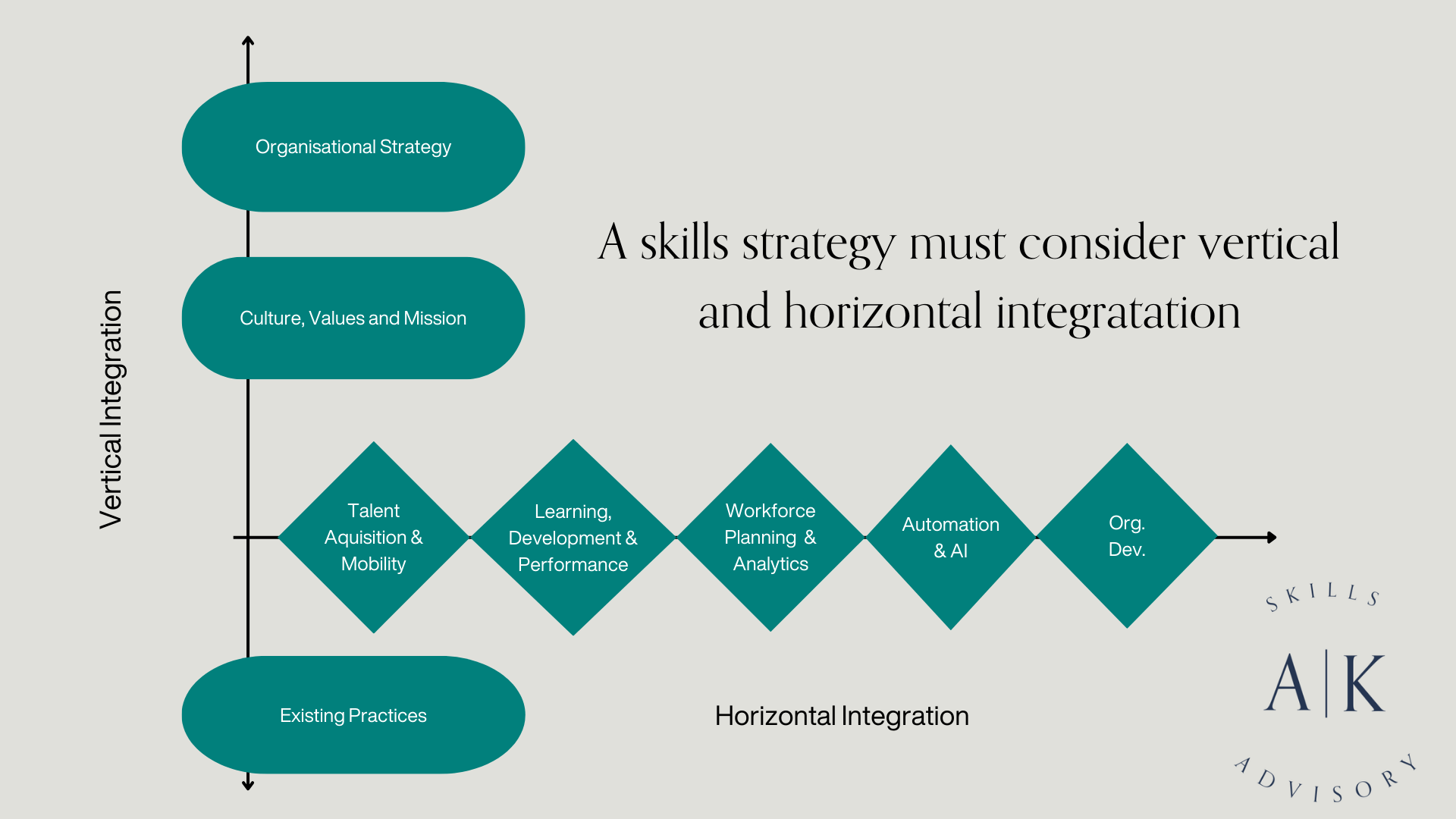
A skills system can be applied to range of different organisational practices including Talent Acquisition & Mobility, Learning & Development, Workforce Planning and Analytics, Automation & AI and Organisational Development.
Each of those different organisational practices will make different demands on your skill system, and require different elements of skill data. Talent Acquisition may benefit from qualitative details, but Workforce Analytics needs quantitative information. Learning and Development can’t operate without concepts of proficiency and dimensions of improvement, but that may not be necessary for Talent Intelligence practices.
We work with you to build out your skills data so that it can be integrated into the function which you are focused on.
Skills Application
Skills Ontology
Your organisation may be setting up an internal talent marketplace, or introducing some form of skills-based management using a technology platform. Your goal may be increasing organisational agility, improving retention, enhanced workforce planning, or all of the above. To get this process started, there is a good chance you may have used either a standard skills library from a provider, extracted skills from your company systems (job descriptions, resumes etc.) and/or relied on some system of self-reporting by employees or managers.
These approaches are one way to get started on a skills journey but face certain limitations. What do the skills look like in your organization? How do you integrated skills with various organisational functions? How important and unique is each skill? Is bias embedded in your skill data? How do you measure skill proficiency?
Without knowing the answers to these questions, your skill system could actually be slowing your organization down, not speeding it up.
You need to decide where to focus your effort on creating a skills system where skills reflect your own organisation’s strategic priorities, actual practices, and which can actually be used to make decisions

This requires research and analysis to understand what the critical skills look like in key areas of your organisation in a way that is measurable, complete, predictive and non-discriminatory.
This increased resolution on your critical skills will provide you with the insights which will both make your skill-technology platform dramatically more useful as an inference tool, and meaningfully address key risks.
Fee structure is negotiable, and can include Hourly Rate or Statement of Work fee structures